
AI Regulation Briefing
Colorado SB 24-205 and the New U.S. AI Compliance Reality: A Practical Guide for High-Risk Industries
Published March 16, 2026 · 10 min read · By Stacksona Research
Colorado’s State Bill 24-205 (SB 24-205), formally the Colorado Artificial Intelligence Act (CAIA), is one of the clearest indicators that AI oversight in the United States is becoming operational. For compliance, legal, and risk teams, the practical question is no longer whether governance is needed, but how quickly controls can be implemented in day-to-day systems.
For years, governance programs often centered on pre-deployment work: model documentation, fairness testing, and training-data review. CAIA, alongside other state requirements and federal enforcement activity, points to a tougher but more realistic standard: governance has to continue after launch, while systems are operating in production.
What Colorado SB 24-205 (CAIA) Requires
Effective June 30, 2026, CAIA applies to organizations that deploy high-risk AI systems making or materially influencing consequential decisions for Colorado residents. That scope covers decisions in areas such as employment, lending, insurance, healthcare, education, and legal-adjacent services.
Core requirements include:
- A documented risk management program aligned to recognized frameworks such as NIST AI RMF or ISO/IEC 42001.
- Recurring impact assessments before deployment, annually, and after substantial modifications.
- Consumer transparency and appeal mechanisms when AI is used in consequential decisions.
- Ongoing discrimination monitoring and remediation when discriminatory outcomes are identified.
The practical takeaway is straightforward: compliance is not a one-time policy document. It is an ongoing operating obligation, and weak controls create legal and reputational exposure over time.
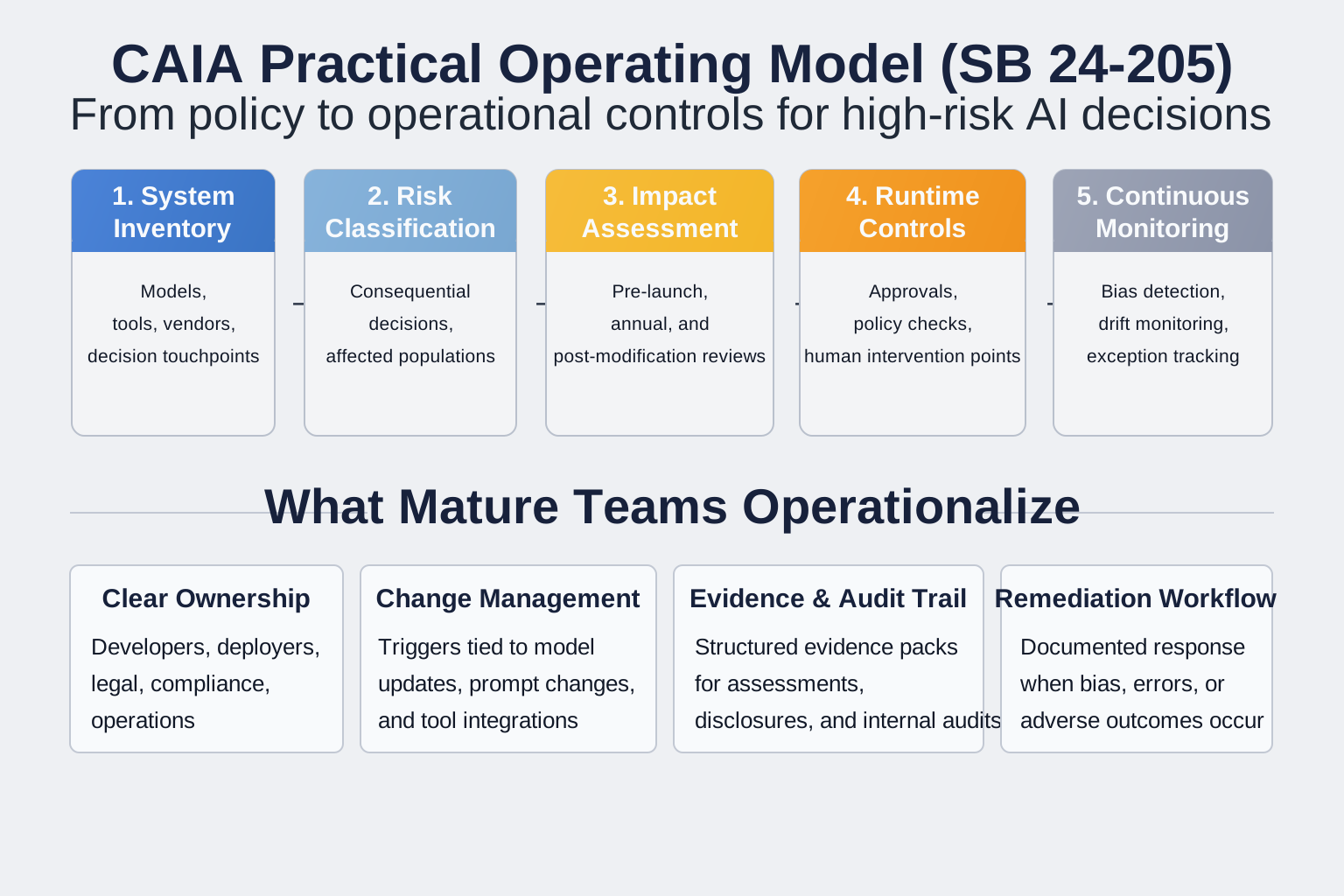
Where Teams Usually Struggle (and How to Avoid It)
Most implementation issues are not about understanding the law at a high level; they are about execution details. Teams often know what is expected in principle but have trouble connecting policy language to production workflows.
- Fragmented ownership: Legal owns policy, engineering owns systems, risk owns reviews—but no shared operating cadence exists.
- Incomplete system inventory: Third-party AI tools, embedded features, and workflow automations are missed in governance scopes.
- Assessment timing gaps: Impact assessments are run once, but not tied to retraining, model swaps, or workflow changes.
- Evidence gaps: Teams cannot easily show what was reviewed, when controls were triggered, and what remediation steps were taken.
A useful way to reduce these issues is to map compliance obligations to a change-management lifecycle. In other words: any meaningful change to a high-impact system should trigger a predictable governance sequence, not an ad-hoc review thread.
A Field Checklist for CAIA-Ready Operations
| Domain | Minimum control to establish | What good looks like in practice |
|---|---|---|
| System inventory | Living register of high-impact systems | Includes model versions, vendors, decision contexts, and owners. |
| Impact assessments | Pre-deployment + recurring + post-change reviews | Assessment schedule is tied to release and retraining pipelines. |
| Human oversight | Defined intervention rights and escalation paths | Reviewers can pause, override, or route outputs with documented rationale. |
| Consumer disclosure | Clear notice and recourse process | Users receive understandable AI-use notice and meaningful appeal flow. |
| Monitoring & remediation | Ongoing checks for bias, drift, and adverse outcomes | Issues trigger ticketed remediation with owners, deadlines, and closure evidence. |
Why Colorado Matters Beyond Colorado
It is easy to view state AI laws as narrow or local. In practice, if systems affect Colorado residents, the law can apply regardless of where teams are located. Multi-state organizations often find it more sustainable to standardize to their strictest applicable baseline rather than maintain fragmented controls by jurisdiction.
Colorado is therefore not just a local rule; it is a practical compliance baseline for U.S. teams preparing for broader regulatory convergence.
How CAIA Connects to Other U.S. AI Regulation Trends
1) FTC enforcement is already active
Federal agencies have made it clear that AI does not create an exemption from consumer protection laws. Enforcement actions tied to deceptive claims, misleading automation promises, and undisclosed risk are already happening. This means AI compliance risk is not hypothetical—regulators can and do act using existing authority.
2) State-level patchwork is expanding
Colorado is not alone. New York City’s Local Law 144 requires bias audits and notice requirements for automated employment decision tools. Illinois imposes transparency and consent obligations for AI-enabled interview analysis. California’s privacy enforcement ecosystem continues evolving with implications for automated decision-making and profiling.
Together, these measures create a fragmented but tightening U.S. regulatory environment. Teams that manage this well typically build shared control foundations that can be adapted by jurisdiction, instead of rebuilding governance processes every quarter.
What High-Risk Industries Should Do in the Next 90 Days
- Inventory every AI system in production. Include third-party tools, embedded model features, and workflow automations that influence consequential outcomes.
- Classify high-impact use cases first. Start with employment, lending, healthcare, insurance, education, legal services, and any function with civil rights or consumer harm implications.
- Implement recurring impact assessments. Tie assessments to release cycles, retraining events, model swaps, and material prompt/logic changes.
- Operationalize human oversight. Define who can intervene, under what triggers, and with what evidence and escalation path.
- Strengthen runtime monitoring and logs. Capture inputs, outputs, interventions, and policy events in a way that supports audit defense.
- Build a consumer-facing disclosure layer. Ensure users can understand AI involvement and access meaningful recourse where required.
The Shift from Model Governance to Execution Governance
The core lesson across Colorado and other U.S. developments is that model-centric governance alone is no longer sufficient. Risks often appear after deployment: novel user inputs, workflow drift, unauthorized tool use, or silent behavior changes after model updates.
Execution governance addresses this gap by enforcing policy in the runtime environment itself. That includes approval gates for sensitive actions, continuous risk checks, machine-readable policy controls, and complete audit trails for how AI decisions were produced and reviewed.
How to Sequence the Next 6 Months
For most teams, progress is easier when work is sequenced into practical phases rather than launched as one large transformation effort.
- Month 1-2: Baseline. Build the inventory, identify consequential decisions, and assign accountable owners.
- Month 2-4: Control design. Define assessments, oversight checkpoints, disclosure templates, and runtime monitoring triggers.
- Month 4-6: Evidence discipline. Standardize logs, review artifacts, remediation records, and internal reporting formats.
This phased approach usually lowers operational friction and gives leadership a clearer view of residual risk as controls mature.
What This Means for 2026 Planning
For organizations in regulated or high-impact sectors, SB 24-205 is best treated as a planning benchmark for 2026 readiness. Waiting for a final enforcement moment usually results in rushed retrofits across policy, tooling, and documentation.
A steadier approach is to build governance iteratively now: maintain a reliable system inventory, prioritize consequential decision points, and embed continuous review mechanisms into production operations.
Further reading:
The Stacksona Q1 2026 AI Agent Compliance Report provides a deeper, source-based analysis of Colorado CAIA, related U.S. and global regulatory developments, and practical execution-governance control patterns. It is available to download at no cost.
Disclaimer: This article is provided for informational purposes only and does not constitute legal or regulatory advice. The information contained herein reflects publicly available sources and regulatory developments as of early 2026. Organizations should consult qualified legal counsel regarding the interpretation and application of applicable laws and regulatory requirements.